
Niobium Metal Quantity Units: A Practical Guide for USA Teams That Buy Materials Online and Need Clear Evidence Before Confirming an Order
This niobium metal quantity units guide focuses on order quantity units. Order quantity units should identify exactly what the supplier is being asked to provide. For a niobium metal enquiry, make the requirement and the supplier’s response specific enough for the next reviewer to understand the decision.
Request a material quotation ↗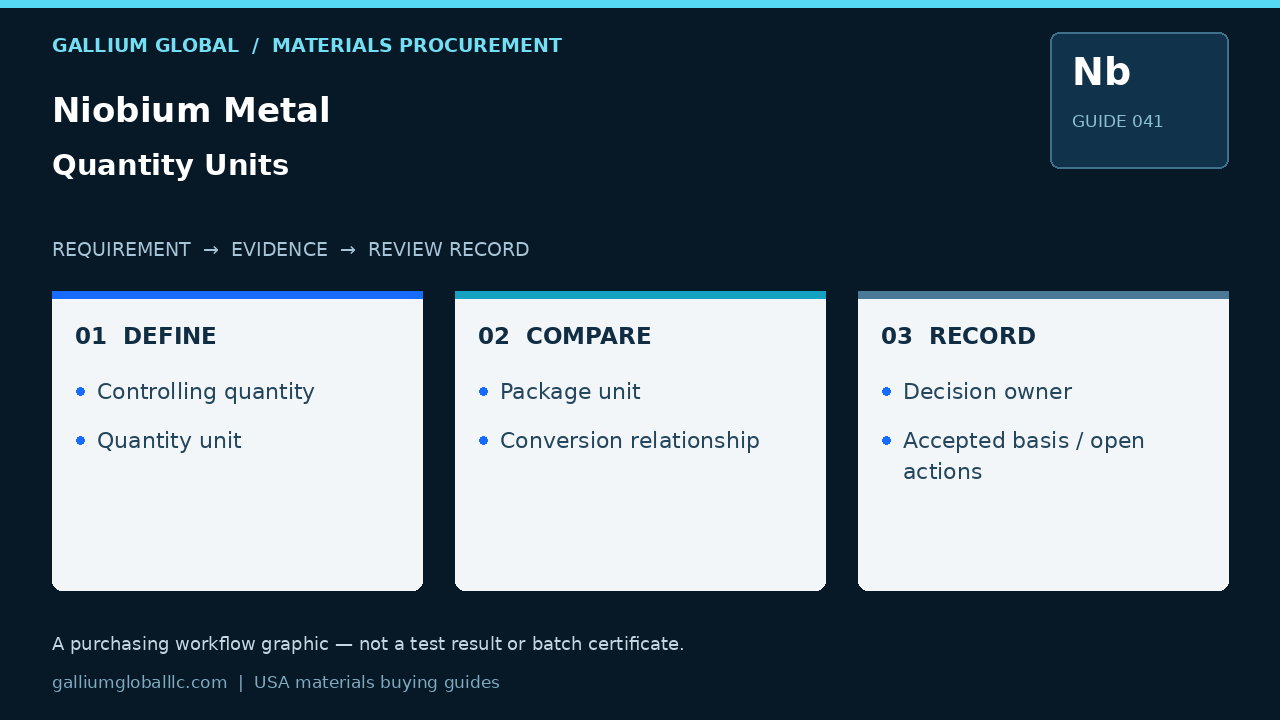
In this guide
Niobium metal quantity units: define the review objective
Order quantity units should identify exactly what the supplier is being asked to provide. Keep pieces, mass and packaging units distinct. If more than one unit is shown, explain their relationship and which quantity controls the purchase.
Niobium Metal: identify the material in scope
Keep a niobium metal enquiry distinct from niobium oxide. Describe the physical form requested and identify the specification used by the purchasing team. A catalog element name does not settle dimensions, unit size or the scope of an analytical response. If stock dimensions or individual impurity limits matter, include them in the requirement and ask for a direct written answer. Keep each accepted condition connected to the same material line and specification revision.
Prepare the evidence record
Create a niobium metal review entry with these fields: controlling quantity, quantity unit, package unit, conversion relationship. Keep the requested condition and the offered answer in separate columns. Add a reference to the document, label or written response that supports the answer. If an entry is missing, record a specific open question instead of filling the gap with an assumed value. The material side of the same record should identify metal identity, specified physical form, controlled dimensions or impurities, order and evidence references. This preserves the connection between the purchasing question and the material actually under review.
Worked purchasing example
Consider this niobium metal purchasing situation. A quotation might identify niobium correctly but leave the supplied unit arrangement unspecified. Resolve that arrangement before passing the response to receiving or production reviewers. An enquiry lists ten bottles without stating the material quantity per bottle. Add both the container count and the required net material quantity. The example illustrates a review sequence, not an actual offer or measured result. For quantity units, the next action is to identify the unresolved field, name the required response and assign the acceptance decision to the responsible reviewer.
Questions to put to the supplier
Ask the supplier to answer the niobium metal requirement in its original scope. For order quantity units, request a direct response to each of the four checklist fields rather than a general assurance. Where the response refers to a document, ask for its identifier and the material or shipment it covers. If the offered form, quantity basis or evidence differs from the enquiry, record that difference as a query requiring a written decision.
Close the review and hand over the record
Close the niobium metal quantity units review only when its accepted basis and remaining actions are visible. Retain the material description, the applicable specification revision and the relevant evidence references in the order file. For a later release, confirm whether the same conditions still apply. Include the agreed record in the next technical, purchasing or receiving handover so another team does not have to reconstruct the decision from scattered messages.
Niobium Metal review checklist
| Record field | What to capture |
|---|---|
| Controlling quantity | State the buyer’s requested condition and reference. |
| Quantity unit | Record the supplier’s offered answer and its scope. |
| Package unit | Identify the supporting document, label or written response. |
| Conversion relationship | Name the reviewer and retain the accepted basis or open action. |
Keep the material requirement visible
- Metal identity
- Specified physical form
- Controlled dimensions or impurities
- Order and evidence references
Catalog context: Niobium Metal product enquiry. Confirm the applicable grade, form and supporting evidence in the quotation.
Niobium metal quantity units: 5 essential checks for better orders
Use these five checks to make the requested amount clear before comparing offers. Niobium metal quantity units should describe the material you need, while packaging instructions describe how that material is divided or presented for delivery.
- Choose the controlling quantity. State whether the order is controlled by net mass, a defined number of pieces or another agreed basis. If both mass and piece count appear, identify which one governs acceptance and which is provided for information. Ask the supplier to identify any proposed difference.
- Write the unit explicitly. Do not leave a quantity as an unlabelled number. State kilograms, grams or pieces in the enquiry and use the same basis when comparing the response. A container count without its contents does not define the material amount.
- Separate packaging from material. Describe the preferred number of containers and net quantity per container separately from the total requirement. This lets the supplier explain an alternative packing arrangement without silently changing the amount of material offered.
- Check the relationship between units. When a quotation shows several quantities, ask how they relate. Distinguish a calculated planning value from a confirmed shipment value and record the source of any conversion used in the comparison.
- Confirm the receiving basis. Explain which records the receiving team needs to reconcile the material with the order. Identify any agreed quantity tolerance explicitly instead of assuming one from a previous purchase or a catalog description.
Niobium metal quantity units: a worked packaging example
Suppose an enquiry requests ten containers, each containing 500 grams of material. The requested net material quantity is 5,000 grams, equivalent to 5 kilograms. The container count is ten; it is not the weight. This is an illustrative calculation, not an offered package size or an availability statement. Record the total and the per-container requirement together so the supplier can respond to both.
If a supplier proposes five containers of 1 kilogram each, the proposed total remains 5 kilograms but the packing arrangement differs. The buyer should decide whether that arrangement meets its handling and receiving needs. Niobium metal quantity units help expose the distinction between a quantity change and a packaging change, which may require separate approvals.
Niobium metal quantity units: pieces and dimensions
For a piece-based requirement, describe the relevant form and dimensions alongside the requested count. Ten pieces of one size are not necessarily equivalent to ten pieces of a different size. If dimensions or unit size are controlled, include the applicable specification and ask the supplier to identify the offered arrangement. Do not estimate final mass from an undefined shape.
Keep niobium metal quantity units consistent across the enquiry, quotation and purchase-order line. Where an approximate mass is useful for planning, identify it as approximate and retain the basis of the estimate. The accepted commercial and receiving quantity should be stated explicitly in the written offer.
Niobium metal quantity units: compare quotations consistently
Place the requested quantity and each supplier’s offered quantity in separate columns. Record the unit, packaging basis and any stated exception. Before comparing totals, confirm that the offers cover the same material scope and quantity. A price per piece and a price per kilogram cannot be compared meaningfully without understanding the supplied item and the applicable quantity relationship.
For niobium metal quantity units, ask which amount is used for invoicing and which supporting record will identify the shipped quantity. Keep those questions connected to the proposed order rather than relying on a general statement about standard packaging. Use our quotation request checklist to collect the wider material and delivery requirements.
Niobium metal quantity units: prepare receiving records
Tell the receiving team which quantity basis was accepted and where to find the supporting documents. A packing list may show both package count and net material quantity; retain their meanings separately. Review our container-markings guide when deciding which references should connect the package with the order line.
Before a repeat order, check niobium metal quantity units again if the supplied form, container arrangement or release quantity changes. A previous shipment can provide context, but the new requirement should still state its own controlling quantity and units.
To clarify niobium metal quantity units for an enquiry, request a niobium metal quotation with the required form, total amount, preferred packing and destination. Highlight any uncertainty about pieces, mass or container contents so it can be resolved in the written response.
Continue your review
Quality and technical documentation · General quotation checklist · All buying guides
General reference: NIST reference-material and certificate definitions. The reference is background reading and does not certify the catalog material.
Niobium metal quantity units: build a clear order line
A useful order line separates the material description, specified form, controlling quantity and packing instruction. Place each requirement in its own field instead of combining them into a phrase such as “ten standard packs.” The supplier can then respond to the material amount and packing arrangement independently. Keep the accepted response with the quotation revision used for the purchasing decision.
For niobium metal quantity units, include both the number and its unit wherever the quantity appears. If a spreadsheet stores the unit in a separate column, make sure that column remains visible when the record is exported or shared. A number copied into an email can lose its meaning when the heading or unit column is omitted.
State whether the amount refers to the initial order, one delivery release or the overall planning requirement. These amounts can differ substantially. A forecast total is useful context, but it should not be mistaken for the quantity to dispatch under a particular purchase order. Ask the supplier to identify the scope covered by its response.
Niobium metal quantity units: review a split delivery
Consider a planning requirement divided into several proposed releases. Record the total planned amount, the requested quantity for each release and the preferred timing in separate fields. Confirm which figures are firm and which remain forecasts. The supplier’s quotation should explain the quantity basis to which its commercial response applies.
Niobium metal quantity units should remain consistent between the release schedule and the main order line. If one table uses kilograms and another uses grams, show the conversion clearly and check the arithmetic. Do not use a package count as a substitute for a release quantity unless the contents of each package have been explicitly defined.
When the release arrangement changes, revise the affected quantities and retain the accepted schedule. A change to shipment frequency does not automatically establish a new total requirement. Review the remaining balance, individual release amounts and packing instructions together so the revised request can be understood without reconstructing earlier messages.
Niobium metal quantity units: distinguish estimates from acceptance values
Planning estimates can help a team decide whether to seek a quotation, but they should be labelled as estimates. A calculated mass based on nominal dimensions may differ from the quantity finally offered or supplied. Explain the purpose of the estimate and ask the supplier to confirm the basis that will govern the proposed order.
Keep niobium metal quantity units visible when recording a tolerance or a permitted range. Identify the value to which the tolerance applies, the unit and the relevant specification reference. Ask for clarification if a response describes a typical arrangement without stating whether it meets the requested acceptance condition.
Do not resolve uncertainty by silently rounding quantities in a comparison sheet. Retain the original offered value, record any calculation separately and explain the basis of the comparison. Where the buyer can accept a different amount, document that decision explicitly before it becomes part of the confirmed order.
Niobium metal quantity units: reconcile the document package
Compare the accepted quotation, purchase order and proposed packing documents before dispatch. Identify the controlling quantity on each record and check whether it describes the same material scope. A difference may be a unit conversion, a packing distinction or a genuine change in the offered amount; investigate it rather than assuming the documents are equivalent.
For niobium metal quantity units, retain a simple reconciliation record showing the requested amount, accepted amount and shipment amount when those figures become available. Record the document reference that supports each entry. This makes it easier for receiving and purchasing to discuss a discrepancy using the same evidence.
Read the quality and technical documentation overview when planning the records needed for the order. Quantity reconciliation and analytical acceptance are separate tasks. A document that identifies a lot may not provide every quantity detail needed by the warehouse, and a packing list does not replace the agreed analytical evidence.
Frequently asked questions about niobium metal quantity units
Is a bottle count enough for a quotation?
Include the requested net material amount per bottle and the total requirement. If the contents are not yet defined, state that uncertainty as a question. A supplier can then propose a packing arrangement for review without the buyer assuming what “one bottle” contains.
Should an order show both kilograms and grams?
It can, provided their relationship is correct and the controlling basis is clear. One kilogram equals 1,000 grams. Use the same agreed unit throughout the core order record where practical, and identify any secondary unit as a conversion rather than a separate requirement.
Can piece count be converted directly to mass?
Only when a supported relationship is available for the specified items. A count alone does not define dimensions, shape or unit mass. Ask the supplier to explain the proposed arrangement and identify whether any stated mass is an estimate or the basis offered for the order.
What if the packing arrangement differs from the enquiry?
Review the total material quantity separately from the container arrangement. An alternative package configuration may preserve the requested total but still affect handling, storage or receiving. Record the buyer’s acceptance of the alternative rather than leaving the difference implicit.
What should the receiving team check?
Provide the accepted quantity basis, the relevant order line and the supporting packing records. Ask receiving to record observed discrepancies with the applicable unit and container reference. The responsible reviewer can then assess the difference under the buyer’s agreed receiving procedure.
How should a repeat enquiry describe its quantities?
State the new requirement explicitly, even when it resembles a previous purchase. Confirm the form, total amount, release basis and packing preference. Referencing an earlier order can provide useful context, but it should not leave the current requested quantity undefined.
When submitting niobium metal quantity units for supplier review, attach the current requirement and identify the person who can resolve open quantity questions. Send the completed enquiry through Request a Quote so the proposed amount, packing and destination can be reviewed together.