
Cerium Oxide Quantity Units: A Practical Guide for USA Teams That Buy Materials Online and Need Clear Evidence Before Confirming an Order
This cerium oxide quantity units guide focuses on order quantity units. Order quantity units should identify exactly what the supplier is being asked to provide. For a cerium oxide enquiry, make the requirement and the supplier’s response specific enough for the next reviewer to understand the decision.
Request a material quotation ↗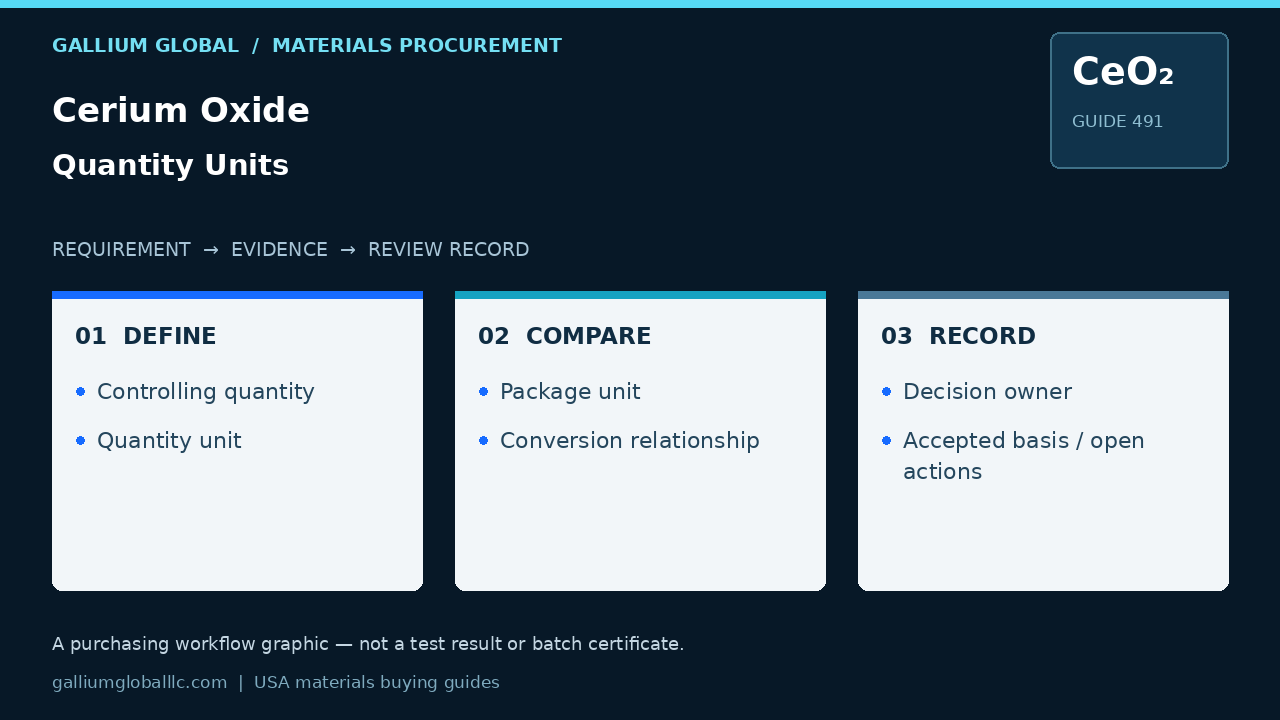
Cerium oxide quantity units: define the review objective
Order quantity units should identify exactly what the supplier is being asked to provide. Keep pieces, mass and packaging units distinct. If more than one unit is shown, explain their relationship and which quantity controls the purchase.
Cerium Oxide: identify the material in scope
Identify cerium oxide as the compound required for the enquiry and distinguish it from cerium metal or a different oxide formulation. If the buyer controls a specific formulation or physical condition, put that requirement into the specification response rather than leaving it implicit. Ask which analytical and physical parameters the quotation actually covers. Record the purity or assay basis, any individual impurity conditions and the powder properties relevant to acceptance. A supplier’s general description should be expanded where it does not answer a controlled requirement.
Prepare the evidence record
Create a cerium oxide review entry with these fields: controlling quantity, quantity unit, package unit, conversion relationship. Keep the requested condition and the offered answer in separate columns. Add a reference to the document, label or written response that supports the answer. If an entry is missing, record a specific open question instead of filling the gap with an assumed value. The material side of the same record should identify compound and formulation, assay or purity basis, controlled physical properties, complete requirement response. This preserves the connection between the purchasing question and the material actually under review.
Worked purchasing example
Consider this cerium oxide purchasing situation. A cerium oxide purchasing review may have a complete material name but an incomplete response to powder or assay conditions. Keep those unanswered lines open and identify the evidence required before the technical review can close. An enquiry lists ten bottles without stating the material quantity per bottle. Add both the container count and the required net material quantity. The example illustrates a review sequence, not an actual offer or measured result. For quantity units, the next action is to identify the unresolved field, name the required response and assign the acceptance decision to the responsible reviewer.
Questions to put to the supplier
Ask the supplier to answer the cerium oxide requirement in its original scope. For order quantity units, request a direct response to each of the four checklist fields rather than a general assurance. Where the response refers to a document, ask for its identifier and the material or shipment it covers. If the offered form, quantity basis or evidence differs from the enquiry, record that difference as a query requiring a written decision.
Close the review and hand over the record
Close the cerium oxide quantity units review only when its accepted basis and remaining actions are visible. Retain the material description, the applicable specification revision and the relevant evidence references in the order file. For a later release, confirm whether the same conditions still apply. Include the agreed record in the next technical, purchasing or receiving handover so another team does not have to reconstruct the decision from scattered messages.
Cerium Oxide review checklist
| Record field | What to capture |
|---|---|
| Controlling quantity | State the amount of material that controls the purchasing request. |
| Quantity unit | Identify the unit for the requested amount and retain the unit used in the supplier response. |
| Package unit | Separate container count and stated contents per container from the material amount. |
| Conversion relationship | Retain source quantities, any conversion basis and the reconciliation between package contents and total material. |
Keep the material requirement visible
- Compound and formulation
- Assay or purity basis
- Controlled physical properties
- Complete requirement response
Catalog context: Cerium Oxide product enquiry. Confirm the applicable grade, form and supporting evidence in the quotation.
Cerium oxide quantity units: 5 essential enquiry checks
Cerium oxide quantity units should tell the supplier exactly how much material the buyer is requesting. A number without a clear unit can leave the enquiry open to several interpretations. A container count may describe packaging, while a mass describes the material requirement. State both when both matter, and identify which value controls the purchasing request. This makes the supplier’s response easier to compare with the buyer’s intended scope.
- State the material amount. Identify the requested numerical quantity and its controlling unit. Keep it on the same line as the material description and specification reference.
- Separate the package description. Record any requested number of containers and the desired contents per container. Do not treat “one package” as a defined amount without further information.
- Explain multiple units. If two units appear, state their relationship and which one controls. Retain the original supplier wording when a conversion needs review.
- Reconcile allocations. Check that quantities assigned to different activities, destinations or releases add up to the total request.
- Compare the offered basis. Ask the supplier to identify its proposed quantity, unit and package arrangement. Record a difference as an alternative or open question rather than accepting it silently.
For cerium oxide quantity units, the objective is an unambiguous enquiry and a traceable response. The checklist does not establish a minimum order, standard package size, available inventory or sales unit. Those details require a current supplier response for the material and scope requested.
Cerium oxide quantity units: choose the controlling unit
Begin cerium oxide quantity units with the amount that purchasing intends to buy. Place the numerical value, unit and material reference together. If the buyer’s system uses an internal unit code, explain it in the enquiry so the supplier does not have to infer its meaning. A code that works within one organisation may not communicate the intended material amount to another.
Keep the controlling unit consistent across the request, comparison sheet and order review. If the supplier responds in a different unit, show both descriptions and the basis used to compare them. Do not replace the supplier’s original quantity with a converted figure without retaining the source. Another reviewer should be able to understand how the comparison was made and which answer was actually received.
Cerium oxide quantity units belong alongside the controlled material definition. The material identity checks guide helps connect the quantity request to the intended compound, form and specification. A clear amount does not resolve an ambiguous material description, and a clear material name does not resolve an undefined quantity.
Distinguish net material amount from package information
Cerium oxide quantity units should not mix the material amount with the weight or count of its packaging. If the requirement is a net material mass, describe it that way. Record container count separately and ask the supplier to state the proposed contents per container. Gross shipment information may be useful for logistics, but it should not be substituted for the material amount in the purchasing comparison.
Packaging descriptions also need scope. Terms such as bottle, bag or drum identify a type of container in ordinary discussion, not a fixed quantity for this enquiry. Ask for the proposed arrangement and the material quantity associated with it. If the buyer requests separately allocated portions, explain whether the portions need individual containers or whether the supplier should propose an alternative for review.
For cerium oxide quantity units, compare the package response with the receiving plan. A combined package and several individually allocated packages may contain the same total material amount while creating different receiving requirements. The container markings guide supports the related identification questions. Confirm how references and quantities will remain understandable when containers are handled separately.
Cerium oxide quantity units: document conversions clearly
When cerium oxide quantity units require conversion for a comparison, retain the original figure and unit. Add a separate converted value, identify the conversion basis and record the unit that controls the review. Use the buyer’s established calculation and checking process. Avoid presenting a rounded comparison figure as the supplier’s exact offered amount or as a revised purchasing requirement.
For example, a buyer’s request and a supplier’s response might use different mass units. The comparison record should identify that difference explicitly. If a price basis uses one unit and a package description uses another, ask how the quoted quantity and package contents relate. Unit conversion does not answer questions about minimum purchase scope, offered package size or commercial qualifications.
Cerium oxide quantity units may also appear in spreadsheets with separate total and per-container columns. Label those columns clearly and retain the calculation relationship. If the total changes after a package allocation is revised, review the whole line rather than updating one cell in isolation. A visible relationship between source values and calculated totals makes an error easier to detect before the enquiry is reissued.
An illustrative container-count example
Consider cerium oxide quantity units in an enquiry that initially requests ten containers without stating the amount of material required in each. The supplier cannot determine the intended aggregate material quantity from that count alone. The buyer revises the request to identify a controlling net material amount and asks the supplier to propose a container arrangement that addresses the stated allocation needs. This is an illustrative review example, not a standard packaging offer.
The supplier’s response is entered in separate fields for total material quantity, unit, container count and stated contents. The reviewer checks whether the proposed contents reconcile with the offered total. Any difference from the buyer’s requested allocation becomes a written question. The record retains the original request so the team can distinguish a clarification from a change in scope.
In this example, cerium oxide quantity units become clear because the package count and material amount are no longer treated as interchangeable. The buyer can review the proposal against the actual requirement. If the proposed package arrangement changes the amount being offered, the reviewer records that change and seeks a decision rather than adjusting the total without explanation.
Reconcile evaluation and production quantities separately
Cerium oxide quantity units should remain clear when an enquiry includes both an immediate evaluation request and a possible future production requirement. Put those quantities on separate lines and label the future figure as planning information if it is not part of the current purchase request. Explain whether the future amount describes one order, several releases or an estimate that still needs definition.
The evaluation quantities guide offers a related workflow for keeping the current objective separate from follow-on questions. A supplier’s response to a small request should not be interpreted as confirmation of a later production amount. Ask for a separate response to the later requirement when its material, quantity and package scope are defined.
For cerium oxide quantity units, allocation records should reconcile with the active enquiry rather than combine provisional forecasts with confirmed requests. Identify who owns each quantity and which record is current. This helps purchasing avoid overstating demand and helps another reviewer understand whether an amount is requested now, under discussion or retained only as context.
Quantities across releases and destinations
Cerium oxide quantity units need an additional reconciliation step when the total is divided across shipments. Give each release an identifier and record its material amount and unit. Show the aggregate total, quantities already allocated in the plan and any unallocated balance. If one release changes, check the resulting total and make the revised relationship visible in the enquiry record.
Use the split deliveries checklist to connect quantities with destinations and timing requests. A destination or date change does not automatically mean the material amount has changed. Conversely, a quantity change may affect package arrangements and receiving allocations even when the destination stays the same. Ask for the supplier’s response to the revised scope.
For cerium oxide quantity units, separate a requested release quantity from a supplier-confirmed amount. The request, response and accepted purchasing basis should remain distinguishable. Do not mark the entire plan as confirmed when the supplier has answered only one release. Keep unresolved amounts visible with an owner and a specific question that can receive a written answer.
Compare quotations on the same quantity basis
A comparison of cerium oxide quantity units should show the requested material amount and the amount covered by each offer. Identify the unit used for any quoted quantity and ask how it relates to package contents. A numerical price comparison is incomplete if the offers describe different amounts or leave their quantity basis unclear. Record the scope before attempting to compare the commercial response.
Review any offered alternatives and qualifications separately. The offer exclusions guide provides a useful structure for separating included, excluded, optional and unresolved items. A quantity difference should receive an explicit decision. Do not assume a larger proposed package is acceptable merely because the total material amount appears close to the request.
When requesting cerium oxide quantity units information, send the material description, requested amount and unit, desired package allocation and known delivery destination through the request a quote page. Ask the supplier to identify the offered quantity basis in its response. Current price, inventory, packing and delivery scope remain subject to quotation and review.
Cerium oxide quantity units: common questions
Does a container count define the order quantity?
A count needs a stated relationship to its material contents. Cerium oxide quantity units should identify the controlling material amount and record package count separately when both matter. Ask for clarification if the proposed contents per container are not defined.
Can the buyer compare offers using different units?
A comparison needs a documented relationship between the units and a clear source for each figure. Retain the offered values and record any converted comparison separately. Conversion alone does not resolve differences in material, packaging or offer scope.
What changes when the requirement is split between sites?
Record the quantity and unit allocated to each destination, then reconcile the allocations with the total. Cerium oxide quantity units should remain linked to release references so a later site change does not hide an unintended quantity change.
What should receiving use as its reference?
Provide the reviewed order or release quantity, controlling unit, proposed package relationship and relevant evidence references. Keep any discrepancy visible for responsible review rather than modifying the purchasing record to match an unexplained shipment difference.
Continue your review
Quality and technical documentation · General quotation checklist · All buying guides
General reference: NIST reference-material and certificate definitions. The reference is background reading and does not certify the catalog material.