
Cerium Oxide Container Markings: How USA Purchasing Teams Can Order Materials Online with Clear Requirements, Supplier Evidence and Receiving Records
This cerium oxide container markings guide focuses on container marking instructions. Container marking instructions should be clear enough to implement consistently. For a cerium oxide enquiry, make the requirement and the supplier’s response specific enough for the next reviewer to understand the decision.
Request a material quotation ↗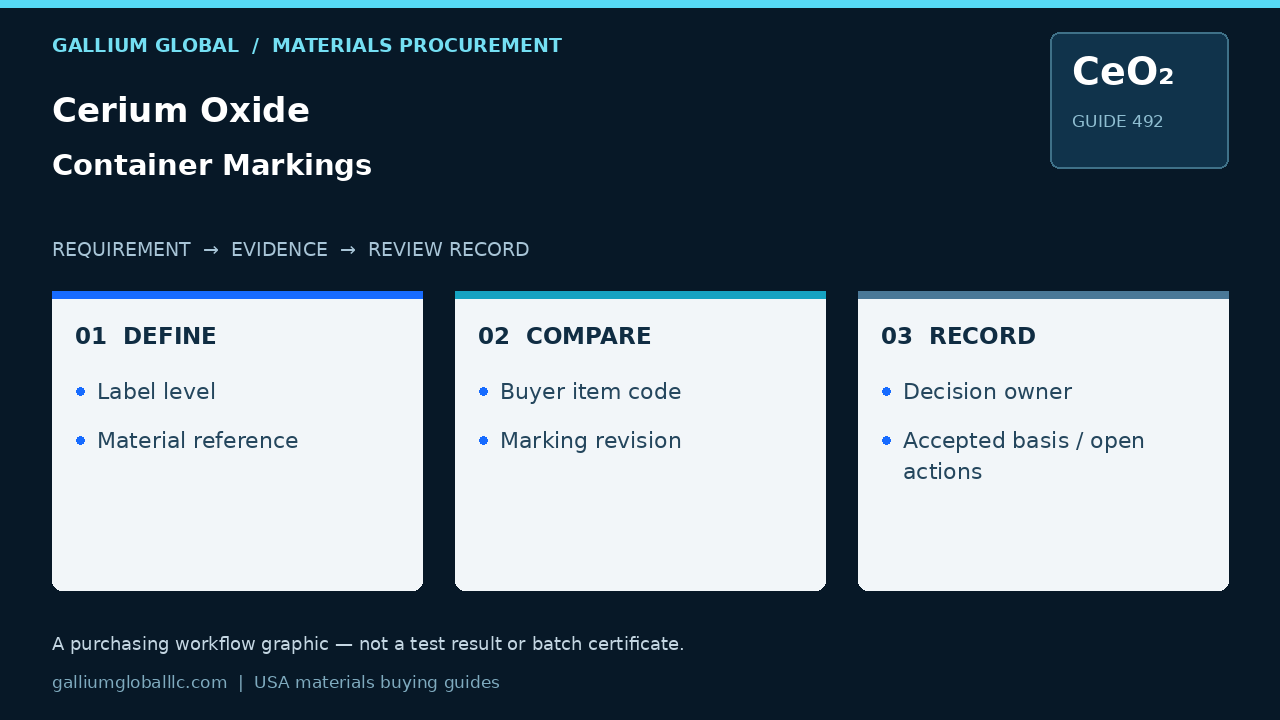
Cerium oxide container markings: define the review objective
Container marking instructions should be clear enough to implement consistently. Identify the references needed for material identification and receiving reconciliation, and distinguish the outer-package instruction from inner-container labels. Review any requested changes before packing is completed.
Cerium Oxide: identify the material in scope
Identify cerium oxide as the compound required for the enquiry and distinguish it from cerium metal or a different oxide formulation. If the buyer controls a specific formulation or physical condition, put that requirement into the specification response rather than leaving it implicit. Ask which analytical and physical parameters the quotation actually covers. Record the purity or assay basis, any individual impurity conditions and the powder properties relevant to acceptance. A supplier’s general description should be expanded where it does not answer a controlled requirement.
Prepare the container marking evidence record
Create a cerium oxide review entry with these fields: label level, material reference, buyer item code, marking revision. Keep the requested condition and the offered answer in separate columns. Add a reference to the document, label or written response that supports the answer. If an entry is missing, record a specific open question instead of filling the gap with an assumed value. The material side of the same record should identify compound and formulation, assay or purity basis, controlled physical properties, complete requirement response. This preserves the connection between the purchasing question and the material actually under review.
Worked purchasing example
Consider this cerium oxide purchasing situation. A cerium oxide purchasing review may have a complete material name but an incomplete response to powder or assay conditions. Keep those unanswered lines open and identify the evidence required before the technical review can close. A buyer changes its internal item code after labels are prepared. Issue a controlled marking revision so old and new codes are not mixed across containers. The example illustrates a review sequence, not an actual offer or measured result. For container markings, the next action is to identify the unresolved field, name the required response and assign the acceptance decision to the responsible reviewer.
Questions to put to the supplier
Ask the supplier to answer the cerium oxide requirement in its original scope. For container marking instructions, request a direct response to each of the four checklist fields rather than a general assurance. Where the response refers to a document, ask for its identifier and the material or shipment it covers. If the offered form, quantity basis or evidence differs from the enquiry, record that difference as a query requiring a written decision.
Close the review and hand over the record
Close the cerium oxide container markings review only when its accepted basis and remaining actions are visible. Retain the material description, the applicable specification revision and the relevant evidence references in the order file. For a later release, confirm whether the same conditions still apply. Include the agreed record in the next technical, purchasing or receiving handover so another team does not have to reconstruct the decision from scattered messages.
Cerium Oxide review checklist
| Record field | What to capture |
|---|---|
| Label level | Identify whether the instruction covers an inner container, an outer package or a shipment record. |
| Material reference | Connect the proposed description and supplier reference to the controlled order line. |
| Buyer item code | Record the complete current buyer code and the purchasing record it identifies. |
| Marking revision | Reference the instruction version, affected packages and supplier response to any change. |
Keep the material requirement visible
- Compound and formulation
- Assay or purity basis
- Controlled physical properties
- Complete requirement response
Catalog context: Cerium Oxide product enquiry. Confirm the applicable grade, form and supporting evidence in the quotation.
Cerium oxide container markings: 5 essential purchasing checks
Cerium oxide container markings should help a receiving team connect a package to the reviewed purchasing record. Clear instructions identify the package level, the reference information requested and the revision that applies. A buyer’s item code, material description and shipment reference each serve a different purpose. Keeping those fields distinct makes the marking request easier to answer and the receiving record easier to reconcile.
- Identify the package level. State whether the requested information belongs on an individual container, an outer package or a shipment record. Do not assume that one instruction covers every level.
- Define the material reference. Use the reviewed material description and explain how the proposed marking will connect to the order and supporting documents.
- Confirm buyer codes. Supply the complete item code and its meaning within the enquiry. Ask the supplier to flag any conflict with another reference rather than choosing one silently.
- Control the revision. Give the marking instruction an identifier and revision. Keep changes visible so an old attachment cannot be mistaken for the current request.
- Record the supplier response. Distinguish the buyer’s requested wording from the proposed arrangement. Retain the evidence that supports the final reviewed basis.
For cerium oxide container markings, a purchasing checklist should support traceability without claiming that a label alone establishes material conformity. The actual material requirement, supplier evidence and receiving review remain part of the record. This article concerns buyer reference information and does not provide a regulatory label design.
Separate inner-container and outer-package information
Start cerium oxide container markings by identifying how the shipment is expected to be organised. Ask which information will be present on each material container and which information belongs only to the outer package. A shipment reference on an outer carton may help route the delivery, while the receiving team may need a material reference on each separately handled container. Explain that practical need in the enquiry instead of relying on the word “labelled.”
Use a short matrix with a row for each package level. Record the requested reference fields, the supplier’s response and the applicable evidence. If the number or type of containers is not yet proposed, mark the arrangement as unresolved. The matrix can then be completed against the actual quotation rather than an assumed package configuration that the supplier has never offered.
Cerium oxide container markings should also be reviewed against the planned allocation after receipt. If containers will be sent to different internal locations, describe the buyer reference needed for that allocation. Do not ask receiving to infer individual contents from an outer label after the packages have been separated. Confirm the identification basis before treating the proposed arrangement as complete.
Link the material name to the controlled requirement
A material description in cerium oxide container markings should be consistent with the material being purchased. Compare the proposed wording with the quotation, order line and relevant technical documents. If the descriptions are abbreviated differently, record how they relate and ask for clarification where the relationship is unclear. Similar-looking names should not be accepted as proof that two records describe the same controlled material.
The cerium oxide material identity checks guide provides a related comparison workflow. Use the approved material name and applicable specification reference from the purchasing record. The label request should not introduce an unreviewed grade claim, additional property or unsupported origin statement simply because it would make the description appear more complete.
For cerium oxide container markings, traceability depends on the relationship between references. A buyer item code identifies the buyer’s internal record; a supplier reference identifies the supplier’s record; a lot reference, where applicable, links the supplied material to relevant evidence. Record the function of each field. Ask the supplier how the proposed identification supports the required document-to-container connection.
Cerium oxide container markings: manage buyer item codes
Cerium oxide container markings often include buyer-specific information that is not part of the supplier’s general material description. Provide the complete code, including any meaningful prefixes or separators. Explain which order line it identifies. If the code changes during review, retain the previous value in the change record and identify the new value explicitly. A shortened or reformatted code can create an unnecessary reconciliation question.
Keep the buyer code distinct from the material description. An internal reference should not be treated as a substitute for explaining what material the enquiry covers. Likewise, the supplier should not have to infer a buyer code from an old quotation or an unrelated receiving record. Send the current reference in the controlled marking instruction and ask for a direct response to that version.
When cerium oxide container markings support more than one release or destination, identify whether the same item code applies across the plan. Use the split deliveries planning guide to connect release references with quantities and receiving locations. Avoid using a destination code as a material identifier unless the purchasing record clearly defines that relationship.
Cerium oxide container markings: control revisions before packing
A revision record for cerium oxide container markings should state what changed, which packages or releases are affected and who needs to respond. Give the instruction a clear identifier and retain the earlier version. If only one reference changes, show the previous and revised values rather than replacing the entire record without an explanation. This helps the supplier identify the requested action and prevents the buyer from overlooking a related field.
Ask whether the proposed marking arrangement has already been prepared when a change is requested. Record the supplier’s response and any open implementation question. Do not assume that sending a revised file proves the change has been completed. Keep the request, acknowledgement and reviewed outcome separate until the responsible reviewer has evidence appropriate to the purchasing requirement.
For cerium oxide container markings, version control is easier when the supporting files appear in a document register. Record the filename or identifier, revision, scope and status. A current instruction should be easy to distinguish from superseded examples, draft artwork and earlier correspondence retained for context.
An illustrative item-code change example
Consider cerium oxide container markings for a buyer whose internal item code changes after a proposed label has been reviewed. The material requirement remains the same, but the receiving system will use the new code. The buyer issues a revised instruction showing the earlier code, replacement code, affected order line and current document revision. This is an example of a review workflow, not an actual shipment or supplier practice.
The supplier is asked to confirm the scope of the proposed update and identify any packages or releases that need further clarification. The buyer records the answer against the revised instruction. If the response covers only a later release, the earlier release stays separately identified. The review does not assume that all packages have been changed merely because the new code appears in one attachment.
In this example, cerium oxide container markings remain understandable because the record preserves both the material identity and the changed administrative reference. Receiving receives the accepted comparison and any unresolved actions relevant to the shipment. The old code is retained in the history, allowing the team to recognise an obsolete reference without silently treating it as a different material.
Connect markings with quantities and supporting evidence
Cerium oxide container markings should be reviewed alongside the proposed package contents. Ask how the stated quantity and unit relate to the material quantity being purchased. Keep net material amount, gross package information and container count distinct in the purchasing record. A package count alone does not establish the contents of each package unless the supplier’s response defines that relationship.
Document references also need an explicit scope. If an offered certificate or other material evidence is intended to cover several containers, ask how the relevant containers can be identified from the record. The representative versus lot-specific certificate guide helps formulate that question. A document title alone does not establish a connection to every container in a shipment.
When reviewing cerium oxide container markings, keep material conformity and identification as related but separate questions. A readable reference supports reconciliation; it does not itself prove that an analytical or physical acceptance requirement has been met. Retain the applicable material evidence and the responsible review decision in addition to the proposed marking information.
Receiving handover and discrepancy questions
A handover for cerium oxide container markings should identify the current reference basis, the expected relationship between package levels and any relevant open questions. Provide the receiving team with the reviewed instruction and supporting document references. This lets the team compare what arrives with the accepted purchasing record instead of relying on an isolated screenshot or an old forwarded email.
If a reference differs, record the observed wording, package level and related order or release information. Ask the responsible team to resolve the discrepancy against the controlled record. Avoid silently correcting the purchasing file to match the package, because that would erase the difference the reviewer needs to understand. Keep the question and written resolution together.
For a new enquiry involving cerium oxide container markings, use the request a quote form with the material description, quantity, destination and requested reference information. Include the current marking instruction or explain what remains to be defined. The supplier can then respond to the actual request without assuming a particular package configuration or special marking service.
Cerium oxide container markings: common questions
Is an internal item code enough to identify the material?
An item code needs a clear relationship to the controlled purchasing record. Cerium oxide container markings should support that relationship alongside the reviewed material description and applicable supplier references. If the code’s scope is unclear, request clarification before closing the review.
Does a proposed label establish material conformity?
A proposed label describes identification information. Material acceptance still depends on the buyer’s requirement, applicable evidence and responsible review. Do not treat a marking example as a certificate, test result or guarantee of suitability.
What should happen when the instruction changes?
Issue a controlled revision, identify the affected scope and ask for a supplier response. Retain the earlier instruction and the change record. Cerium oxide container markings should not mix current and obsolete buyer references without an explained, reviewed basis.
Should a quotation confirm special marking requests?
Ask the supplier to address the specific request and identify any limitations or unresolved details. Keep the answer with the offer revision. General catalog information does not establish that a particular package arrangement or buyer-specific instruction is included.
Continue your review
Quality and technical documentation · General quotation checklist · All buying guides
General reference: NIST reference-material and certificate definitions. The reference is background reading and does not certify the catalog material.