
Cerium Oxide Evaluation Quantities: What USA Buyers Should Review Before They Buy or Order Materials Online and Confirm a Supplier Quotation
This cerium oxide evaluation quantities guide focuses on production versus evaluation quantities. Evaluation quantities and production quantities can have different purchasing objectives. For a cerium oxide enquiry, make the requirement and the supplier’s response specific enough for the next reviewer to understand the decision.
Request a material quotation ↗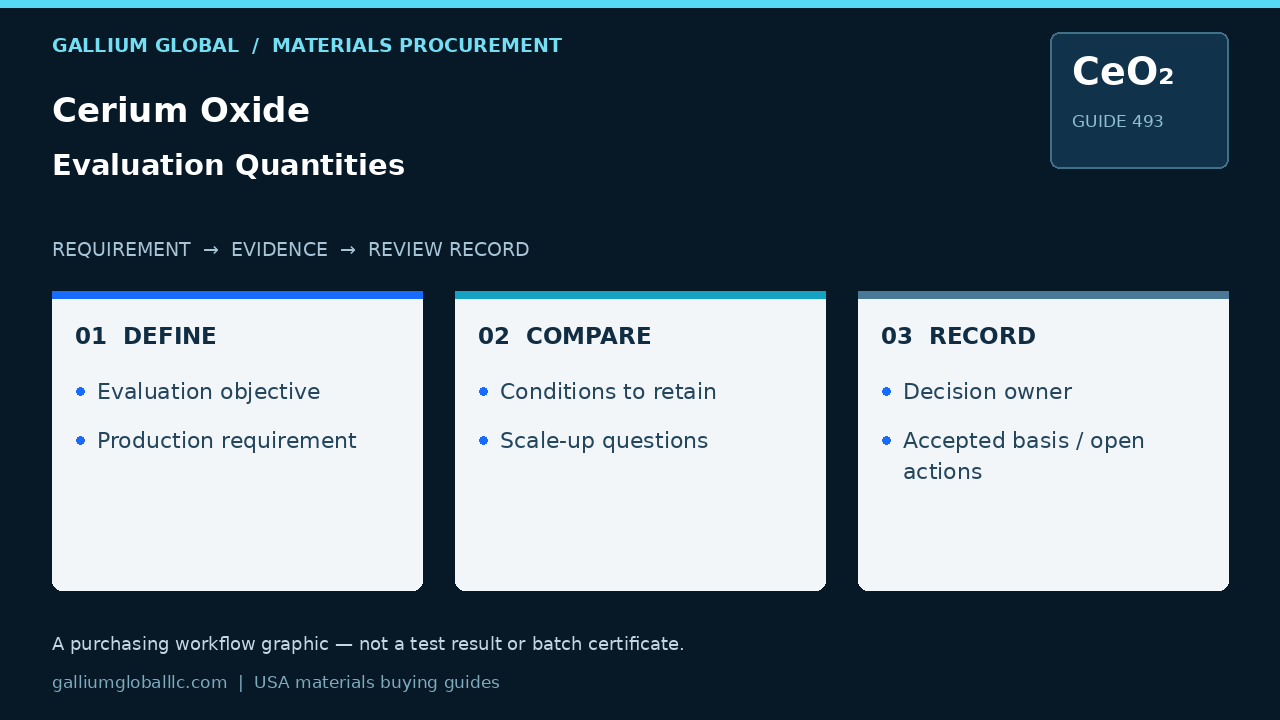
Cerium oxide evaluation quantities: define the review objective
Evaluation quantities and production quantities can have different purchasing objectives. State what the evaluation is intended to establish and identify which conditions must remain consistent for a later scale-up review. Do not assume that a small trial settles every production requirement.
Cerium Oxide: identify the material in scope
Identify cerium oxide as the compound required for the enquiry and distinguish it from cerium metal or a different oxide formulation. If the buyer controls a specific formulation or physical condition, put that requirement into the specification response rather than leaving it implicit. Ask which analytical and physical parameters the quotation actually covers. Record the purity or assay basis, any individual impurity conditions and the powder properties relevant to acceptance. A supplier’s general description should be expanded where it does not answer a controlled requirement.
Prepare the evaluation evidence record
Create a cerium oxide review entry with these fields: evaluation objective, production requirement, conditions to retain, scale-up questions. Keep the requested condition and the offered answer in separate columns. Add a reference to the document, label or written response that supports the answer. If an entry is missing, record a specific open question instead of filling the gap with an assumed value. The material side of the same record should identify compound and formulation, assay or purity basis, controlled physical properties, complete requirement response. This preserves the connection between the purchasing question and the material actually under review.
Worked evaluation purchasing example
Consider this cerium oxide purchasing situation. A cerium oxide purchasing review may have a complete material name but an incomplete response to powder or assay conditions. Keep those unanswered lines open and identify the evidence required before the technical review can close. A small evaluation uses one packing arrangement, while production will use another. Include the packing change in the follow-on qualification review. The example illustrates a review sequence, not an actual offer or measured result. For evaluation quantities, the next action is to identify the unresolved field, name the required response and assign the acceptance decision to the responsible reviewer.
Evaluation questions to put to the supplier
Ask the supplier to answer the cerium oxide requirement in its original scope. For production versus evaluation quantities, request a direct response to each of the four checklist fields rather than a general assurance. Where the response refers to a document, ask for its identifier and the material or shipment it covers. If the offered form, quantity basis or evidence differs from the enquiry, record that difference as a query requiring a written decision.
Close the evaluation review and hand over the record
Close the cerium oxide evaluation quantities review only when its accepted basis and remaining actions are visible. Retain the material description, the applicable specification revision and the relevant evidence references in the order file. For a later release, confirm whether the same conditions still apply. Include the agreed record in the next technical, purchasing or receiving handover so another team does not have to reconstruct the decision from scattered messages.
Cerium Oxide review checklist
| Record field | What to capture |
|---|---|
| Evaluation objective | Identify the activity, intended decision, scope and responsible reviewer. |
| Production requirement | Separate indicative future quantities and package needs from the current evaluation request. |
| Conditions to retain | Reference the material definition, specification revision and evidence basis for comparison. |
| Scale-up questions | List changed or unresolved production conditions, their owners and required supplier responses. |
Keep the material requirement visible
- Compound and formulation
- Assay or purity basis
- Controlled physical properties
- Complete requirement response
Catalog context: Cerium Oxide product enquiry. Confirm the applicable grade, form and supporting evidence in the quotation.
Cerium oxide evaluation quantities: 5 essential planning checks
Cerium oxide evaluation quantities should be tied to a clear purchasing objective. A small request might support an initial handling review, a comparison against a controlled requirement or a buyer’s defined trial. Those objectives are different from committing to ongoing production supply. Explain what the evaluation needs to establish, what evidence the reviewer expects and which questions will remain open for a later order.
- Name the decision. Describe the decision that the evaluation is intended to inform. Avoid a broad statement such as “approve material” if the activity only addresses a limited characteristic.
- Identify the material. Reference the required compound, formulation, grade basis and applicable specification revision. A quantity without a material definition cannot receive a complete purchasing response.
- Define the requested quantity. Use a controlling unit and explain any allocation between activities. Separate the material quantity from the number of packages.
- State the evidence requirement. Ask which technical information and material-specific documents the supplier can provide. Keep representative literature distinct from evidence for supplied material.
- List follow-on questions. Record production quantities, packaging changes and repeat-order requirements that will require a later response. An evaluation enquiry does not confirm a production offer.
For cerium oxide evaluation quantities, these checks help the supplier understand the request without inferring an application or acceptance limit. The buyer’s responsible technical team should define the evaluation itself. This guide addresses purchasing records and supplier questions; it does not prescribe a laboratory method or establish material suitability.
Define the purpose before choosing a request size
Start cerium oxide evaluation quantities with the activity that needs material and the decision owner. Record whether the request supports a preliminary document review, an internal trial or a comparison of proposed supply options. State the intended scope in plain language. If the objective is narrow, keep the conclusion narrow too. A useful outcome might be completion of one review stage with several production questions still outstanding.
A quantity calculation should distinguish planned consumption, separately retained material and any buyer-defined allowance. Record the assumptions that support each allocation. Do not add an arbitrary percentage and describe it as a supplier requirement. If the technical team has not yet defined the required amount, mark the quantity as provisional and ask for the information needed to finalise the enquiry.
Cerium oxide evaluation quantities also need a clear boundary between the request and the offered answer. Ask the supplier to state its proposed quantity, unit and package arrangement. An offered package that differs from the requested quantity should be recorded as an alternative for review. The buyer can then decide whether the proposal supports the intended activity rather than treating the difference as an administrative detail.
Keep the material definition consistent
The material definition for cerium oxide evaluation quantities should include the controlled properties relevant to the buyer’s requirement. Identify the compound and formulation, the stated assay or purity basis and any specified physical characteristics. A general name or headline percentage may not answer every line of a purchasing specification. Ask for a response to the actual controlled conditions and retain the applicable revision.
Where the requirement includes particle-size information, use the buyer’s specified description and request the corresponding supplier response. The particle-size specification guide offers a related purchasing checklist. It does not establish an acceptance limit for this enquiry. The appropriate parameters and criteria must come from the controlled requirement and the responsible reviewer.
For cerium oxide evaluation quantities, check that the quotation, supporting literature and proposed material description refer to the same scope. The cerium oxide material identity checklist can help organise the comparison. If descriptions differ, raise a written question before assuming that the documents describe an interchangeable material.
Separate sample amount, package count and production demand
Cerium oxide evaluation quantities can be expressed in several ways during early discussions. An internal team might describe an amount of material, while a supplier proposes a package configuration. Record both descriptions without treating them as equivalent. Show the requested net material quantity and controlling unit, then capture the proposed number of containers and stated contents per container. Ask for clarification when those details do not reconcile.
Production demand belongs in a separate field. If the buyer has an indicative future quantity, label it as planning information and distinguish it from the current evaluation request. Explain whether the figure describes one later order or a forecast across several releases. Do not present a forecast as a firm purchase commitment or assume that a response to the evaluation quantity also prices the production requirement.
When cerium oxide evaluation quantities are allocated across several activities, use an allocation record with one line per activity. Identify the quantity owner and reconcile the total with the purchasing request. This allows changes to be reviewed before the order scope is revised. It also gives receiving a practical basis for distributing material without relying on informal instructions detached from the enquiry.
Documentation for cerium oxide evaluation quantities
Ask what documentation is proposed for cerium oxide evaluation quantities and when it will be available. Separate a technical data sheet, a safety data sheet, a representative certificate and any offered lot-specific evidence in the record. They serve different purchasing purposes. A file labelled “certificate” should still be reviewed for its identifier, material scope and relationship to the proposed supply.
The COA, SDS and technical data sheet guide helps distinguish common document categories. Use it to frame precise questions, then compare the actual documents with the buyer’s requirement. A general reference or product page does not certify the material. Any order-specific evidence requirement should be included explicitly in the enquiry so the supplier can respond.
For cerium oxide evaluation quantities, maintain a document register with the identifier, revision, source, scope and review status of each file. The cerium oxide document registers guide provides a useful structure. If a document is revised during the evaluation, record which version supported the earlier decision and whether the change requires further review.
An illustrative evaluation-to-production comparison
Consider a buyer requesting cerium oxide evaluation quantities for a defined internal activity while anticipating a larger requirement later. The evaluation enquiry identifies a controlled material description and a small-package request. The production plan anticipates a different package arrangement and several receiving releases. These are illustrative planning conditions, not actual stock, package options or a supplier commitment.
The reviewer creates two columns: current evaluation scope and future production questions. The current column records the requested amount, material specification, proposed evidence and evaluation destination. The future column records the anticipated quantity basis, package change, release plan and consistency questions. The supplier is asked to answer the current request and identify which future questions need a separate production enquiry.
In this example, cerium oxide evaluation quantities support a limited decision. Completion of the internal activity does not close the package-change question or confirm the future supply arrangement. The buyer carries those items into the next review and requests a fresh response. The result is a traceable progression between purchasing stages without implying that one small order has established every condition of a later requirement.
Record differences before a follow-on enquiry
Cerium oxide evaluation quantities and production quantities may differ in more than size. Review the proposed material description, package configuration, document scope, destination and release arrangement side by side. Record whether each condition is unchanged, changed or not yet answered. This comparison helps the responsible team decide what needs further review without assuming that every difference is unacceptable or immaterial.
If the later requirement uses several shipments, the cerium oxide split deliveries guide offers a release-planning checklist. Tie each proposed shipment to its quantity, destination and requested timing basis. A successful evaluation does not establish availability for all later releases. Ask for the current supplier response to the follow-on plan.
For cerium oxide evaluation quantities, any claim of continuity should have a defined basis. Ask which material description and controlled conditions would apply to the later offer. If the buyer requires particular evidence of consistency, state that requirement directly. Do not assume that identical catalog wording proves identical lot characteristics or that a previous document automatically covers a future shipment.
Close the evaluation record with a bounded decision
The closure record for cerium oxide evaluation quantities should identify the activity reviewed, material evidence used, conclusion owner and limits of the decision. Reference the applicable specification and document versions. Separate the buyer’s internal evaluation conclusion from the supplier’s commercial response. Neither record should silently expand the scope of the other.
List open actions for the next stage with an owner and required response. Examples might include confirmation of a production package, clarification of a document requirement or definition of future release quantities. Keep those items visible even when the current evaluation activity is complete. This makes the handover useful to a different purchasing or technical reviewer who was not involved in the original enquiry.
Before ordering further cerium oxide evaluation quantities or requesting production supply, use the request a quote page with the current requirement and outstanding questions. Explain what has changed since the earlier request. A complete enquiry enables a more specific response while leaving price, available quantities, timing and offered scope subject to confirmation.
Cerium oxide evaluation quantities: common purchasing questions
Is there one standard evaluation quantity?
This guide does not establish a standard quantity or a minimum order. Cerium oxide evaluation quantities should follow the buyer’s defined activity and the supplier’s current response. Request the amount and unit needed, then review any proposed package alternative explicitly.
Does a trial result approve future production supply?
A conclusion should remain within its reviewed scope. Cerium oxide evaluation quantities may inform one stage of a purchasing decision, while production packing, document scope, future lots and release plans still require separate questions and responsible review.
What if the supplier proposes a different amount?
Record the proposed amount and package basis alongside the original request. Ask the technical and purchasing owners whether the alternative supports the planned activity. Keep any accepted change in the enquiry record rather than adjusting the quantity without explanation.
What should be retained for a repeat request?
Retain the material definition, requested and supplied quantity bases, applicable document references, review conclusion and open follow-on actions. For cerium oxide evaluation quantities, this provides a clear starting point for a new enquiry while keeping current confirmation separate from earlier experience.
Continue your review
Quality and technical documentation · General quotation checklist · All buying guides
General reference: NIST reference-material and certificate definitions. The reference is background reading and does not certify the catalog material.