
Cerium Oxide Split Deliveries: A Practical Guide for USA Teams That Buy Materials Online and Need Clear Evidence Before Confirming an Order
This cerium oxide split deliveries guide focuses on split delivery requests. A split-delivery request should describe each planned shipment rather than only the aggregate order. For a cerium oxide enquiry, make the requirement and the supplier’s response specific enough for the next reviewer to understand the decision.
Request a material quotation ↗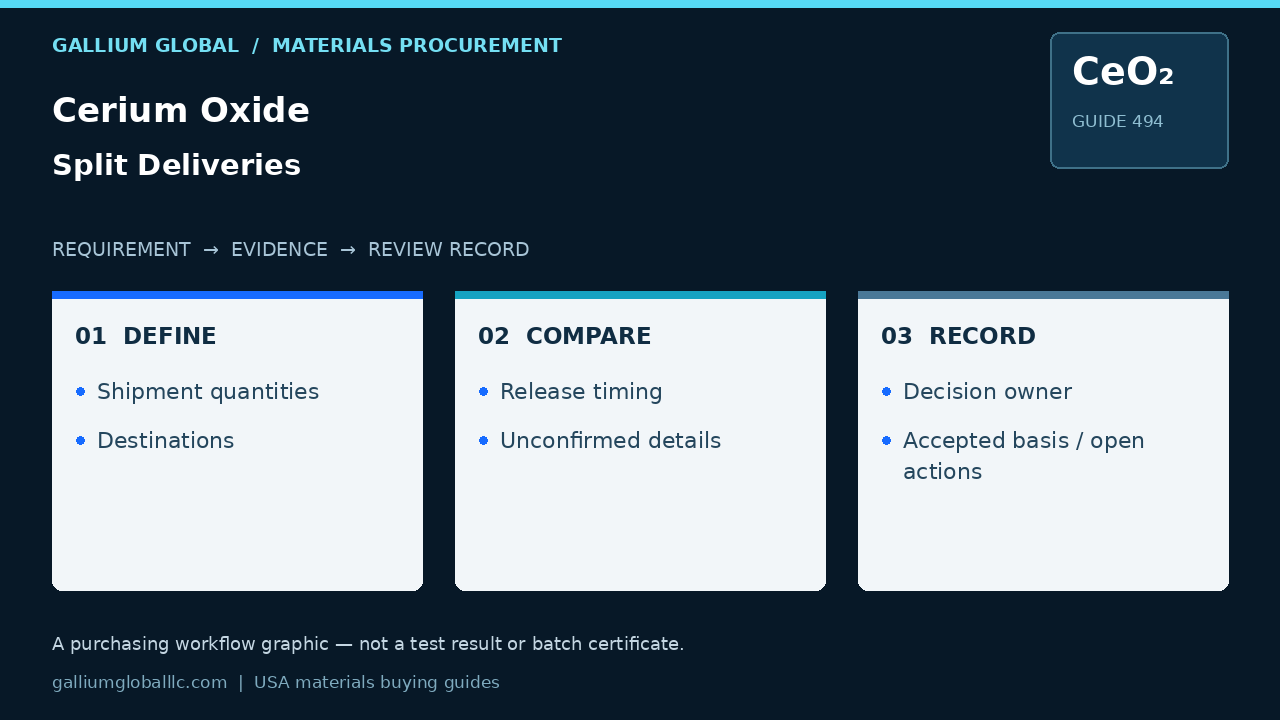
Cerium oxide split deliveries: define the review objective
A split-delivery request should describe each planned shipment rather than only the aggregate order. Identify quantities, destinations and timing expectations per release. Ask which conditions depend on later confirmation and keep those dependencies visible.
Cerium Oxide: identify the material in scope
Identify cerium oxide as the compound required for the enquiry and distinguish it from cerium metal or a different oxide formulation. If the buyer controls a specific formulation or physical condition, put that requirement into the specification response rather than leaving it implicit. Ask which analytical and physical parameters the quotation actually covers. Record the purity or assay basis, any individual impurity conditions and the powder properties relevant to acceptance. A supplier’s general description should be expanded where it does not answer a controlled requirement.
Cerium oxide split deliveries: prepare the evidence record
Create a cerium oxide review entry with these fields: shipment quantities, destinations, release timing, unconfirmed details. Keep the requested condition and the offered answer in separate columns. Add a reference to the document, label or written response that supports the answer. If an entry is missing, record a specific open question instead of filling the gap with an assumed value. The material side of the same record should identify compound and formulation, assay or purity basis, controlled physical properties, complete requirement response. This preserves the connection between the purchasing question and the material actually under review.
Cerium oxide split deliveries: worked purchasing example
Consider this cerium oxide purchasing situation. A cerium oxide purchasing review may have a complete material name but an incomplete response to powder or assay conditions. Keep those unanswered lines open and identify the evidence required before the technical review can close. A total quantity is to be delivered in three installments, but only the first destination is confirmed. Record the remaining destinations as unresolved release information. The example illustrates a review sequence, not an actual offer or measured result. For split deliveries, the next action is to identify the unresolved field, name the required response and assign the acceptance decision to the responsible reviewer.
Cerium oxide split deliveries: questions to put to the supplier
Ask the supplier to answer the cerium oxide requirement in its original scope. For split delivery requests, request a direct response to each of the four checklist fields rather than a general assurance. Where the response refers to a document, ask for its identifier and the material or shipment it covers. If the offered form, quantity basis or evidence differs from the enquiry, record that difference as a query requiring a written decision.
Cerium oxide split deliveries: close the review and hand over the record
Close the cerium oxide split deliveries review only when its accepted basis and remaining actions are visible. Retain the material description, the applicable specification revision and the relevant evidence references in the order file. For a later release, confirm whether the same conditions still apply. Include the agreed record in the next technical, purchasing or receiving handover so another team does not have to reconstruct the decision from scattered messages.
Cerium Oxide review checklist
| Record field | What to capture |
|---|---|
| Shipment quantities | Identify each release quantity, controlling unit and relationship to the aggregate requirement. |
| Destinations | State the receiving location for each release or identify an unresolved destination and its owner. |
| Release timing | Separate requested dispatch or arrival events from the timing basis stated in the supplier response. |
| Unconfirmed details | List open questions, action owners and the response required before the affected release can close. |
Keep the material requirement visible
- Compound and formulation
- Assay or purity basis
- Controlled physical properties
- Complete requirement response
Catalog context: Cerium Oxide product enquiry. Confirm the applicable grade, form and supporting evidence in the quotation.
Cerium oxide split deliveries: 5 essential checks before requesting releases
Cerium oxide split deliveries need a plan that connects the overall requirement to each shipment. A total quantity alone does not tell a supplier which portion should move first, where each portion belongs, or what must be approved before dispatch. Build the enquiry around release lines so purchasing, technical review and receiving can work from the same record. The following checks are a practical planning method, not a statement of stock, lead time or agreed supply terms.
- Define the overall quantity. State the material, controlling quantity unit and aggregate requirement. Make clear whether each release is part of that total or an additional request.
- Identify every release. Give each planned shipment a reference that remains stable when dates change. Keep a cancelled release visible instead of reusing its number for another destination.
- Separate timing events. Distinguish requested dispatch, requested arrival and any production-use milestone. Ask the supplier which event its response actually addresses.
- Confirm the destination. Record the receiving site and the information needed to route the shipment. A billing address does not automatically identify the receiving location.
- List release conditions. Show which technical approvals, document responses and buyer instructions remain outstanding. Name the person responsible for clearing each condition.
For cerium oxide split deliveries, an unanswered release line should stay visibly open. A supplier’s acknowledgement of the enquiry does not by itself confirm every proposed shipment. Keep the requested plan and the supplier’s response in separate columns until the responsible reviewer accepts a clear basis.
Build a release matrix for cerium oxide split deliveries
A useful release matrix has one row per intended shipment and a separate summary of the total requirement. Include the release identifier, material specification revision, quantity and unit, destination, requested timing event, supplier response, required documents and current status. Add a revision reference to the matrix itself. This makes it possible to compare a later response with the plan that was actually issued, rather than reconstructing the enquiry from several messages.
In cerium oxide split deliveries, quantity reconciliation matters whenever a release is increased, reduced or cancelled. Show the previous quantity, the revised quantity and the resulting unallocated balance. If the requirement is expressed as net material mass, distinguish that mass from the number of containers. Do not silently convert container counts into material quantities without an agreed basis for the contents of each container.
The release matrix should be readable without opening every attachment. Use short descriptions in the row and reference the detailed evidence elsewhere. For document naming and version control, the cerium oxide document registers guide provides a related checklist. Cross-references help another reviewer find the applicable record; they do not replace the need for a direct answer to the release requirement.
Requested timing and confirmed timing are different records
Cerium oxide split deliveries can involve several timing requests within one enquiry. Describe each request precisely enough to distinguish a shipment leaving the supplier from a shipment reaching a receiving site. If a requested arrival is linked to a planned production activity, record that dependency without turning the buyer’s preferred date into a supplier commitment. Ask for the offered timing basis and any conditions that remain unresolved.
Keep changes to timing visible. Record who requested the change, which release it affects and whether the supplier has responded. The cerium oxide schedule revisions checklist helps structure that comparison. A later email discussing one release should not be treated as an amendment to every release unless the response expressly covers the wider plan.
For cerium oxide split deliveries, a status such as “requested,” “under review” or “supplier response received” is often more informative than a single ambiguous date. Use the team’s own status definitions and explain them in the record. Close a timing question only after the responsible person has reviewed the relevant response. This avoids presenting an internal planning assumption as confirmed availability.
Keep material acceptance consistent across releases
Cerium oxide split deliveries should reference the material requirement applicable to each release. The compound name is only part of that description. Carry forward the controlled formulation, assay or purity basis, physical properties and any individual acceptance conditions that the buyer has specified. If one release needs a different requirement, identify it as a distinct line and request a separate response rather than hiding the difference in a delivery note.
Document scope also needs attention. A general technical sheet may describe a product family while an order-specific response addresses a particular enquiry. A lot-specific certificate, when required and offered, has a different role from representative information. The guide to representative and lot-specific certificates explains the purchasing distinction. Ask which evidence will accompany each proposed shipment and how the evidence will be linked to the material received.
If cerium oxide split deliveries may use more than one lot, ask how the proposed allocation will be identified. Do not assume one lot for the whole order or assume a new lot for every shipment. Record the supplier’s answer and the buyer’s applicable review requirement. Any need for consistent lot allocation should be raised in the enquiry so it can receive an explicit response before release.
Destinations, package quantities and receiving instructions
For cerium oxide split deliveries to different sites, each destination needs its own receiving information. Identify the site, receiving contact or function, relevant reference and any buyer-controlled delivery instructions. Keep the destination record tied to the release identifier. If a location is still being decided, show it as unresolved and assign an owner to provide it. A placeholder address should never be mistaken for a confirmed shipping instruction.
Package requirements should describe the buyer’s need without inventing a supplier’s standard configuration. Ask for the proposed number of containers, material quantity per container and identification approach. Where receiving intends to allocate material to separate departments, explain the requested allocation. The supplier can then respond to the practical request rather than guessing whether a single combined package is acceptable.
Cerium oxide split deliveries also benefit from a clear boundary between purchasing review and transport arrangements. Record the shipment scope stated in the quotation and ask about anything that is absent or unclear. The shipping and delivery enquiry page is a starting point for questions. Specific arrangements still need written confirmation for the proposed order and destination.
An illustrative three-release purchasing example
Consider a buyer planning cerium oxide split deliveries across three internal releases. The overall material quantity is defined, but the final receiving site for the third release has not been chosen. Release A has a stated quantity, destination and requested arrival event. Release B has a destination but needs clarification of the timing basis. Release C has an allocated quantity and an open destination field. These are illustrative review conditions, not an actual offer.
The buyer sends a matrix showing all three releases and asks for a response against each row. The supplier’s reply addresses A and requests further information for B and C. The reviewer records the response for A within its stated scope, leaves B’s timing question open and assigns C’s destination decision to the buyer. The record does not describe all three shipments as confirmed merely because the overall enquiry received a reply.
In this example, cerium oxide split deliveries become easier to review because unresolved items are specific. A useful follow-up identifies the release, quotes the open question and references the current matrix revision. If the buyer changes B’s quantity, the total and unallocated balance are reconciled before a revised enquiry is issued. The team can then distinguish a new request from a clarification of the original one.
Review quotation scope for cerium oxide split deliveries
A quotation for cerium oxide split deliveries should be compared with the release plan that the buyer issued. Check whether the response addresses the aggregate quantity only or also addresses individual shipments. Review any qualifications concerning packing, documentation, inspection, destination information or release timing. A statement covering one shipment should not be applied to the entire plan without a clear basis in the response.
Keep included scope, excluded scope, optional items and unresolved questions distinct. The cerium oxide offer exclusions guide supports this comparison. If a requirement is missing from a quotation, ask a direct question rather than assuming it is either included or excluded. Record the written clarification and its relationship to the current offer revision.
When preparing cerium oxide split deliveries, send the supplier enough information to answer the actual request. Use the request a quote form with the material specification, total quantity, proposed release quantities and known destinations. Identify open planning items explicitly. Requesting a quotation starts a review; it does not establish price, inventory, shipment dates or acceptance of purchasing terms.
Control changes after the first proposed release
Cerium oxide split deliveries may require revisions as the buyer’s plan develops. Retain the earlier matrix, identify the affected release and explain the requested change. Check whether quantity, destination, documentation or timing is also affected. A change described as a simple date adjustment can still require review if it alters a dependency elsewhere in the plan. Ask the supplier to respond to the revised scope.
Use a short action log with an owner, required response and status for each open item. Reference the evidence that closes the item and record who accepted the answer. Avoid deleting the earlier request once a response arrives. The earlier version explains what changed and helps prevent a receiving team from acting on an obsolete instruction forwarded from an old message.
For recurring cerium oxide split deliveries, carry forward only the conditions that have been reviewed for the new requirement. The recurring supply planning guide offers a related enquiry structure. Previous shipment experience can help formulate questions, but it should not substitute for current confirmation of material scope, release information and supplier response.
Cerium oxide split deliveries: practical questions
Does one total quantity confirm all shipments?
No. A total describes the aggregate request. Cerium oxide split deliveries still need individual release quantities, destinations, timing bases and supplier responses. Keep the total and each release visible so the reviewer can identify what is covered and what remains open.
Can different receiving sites use the same release reference?
Use references that let the team distinguish the shipments reliably. If a single release is divided between sites, show the allocations explicitly. The aim is a traceable relationship between the requested material, shipment record and receiving location.
What should happen when a later destination is unknown?
Record the destination as unresolved, identify who will provide it and ask how that open item affects the supplier’s response. Cerium oxide split deliveries should not show an unknown location as approved routing information.
What belongs in the receiving handover?
Provide the current release reference, material requirement, expected quantity and unit, destination, applicable evidence references and unresolved actions relevant to receiving. Keep the handover aligned with the reviewed supplier response. For cerium oxide split deliveries, this gives receiving a clear basis for checking the shipment instead of relying on the overall order total.
Continue your review
Quality and technical documentation · General quotation checklist · All buying guides
General reference: NIST reference-material and certificate definitions. The reference is background reading and does not certify the catalog material.