
Cerium Oxide Schedule Revisions: What USA Buyers Should Review Before They Buy or Order Materials Online and Confirm a Supplier Quotation
This cerium oxide schedule revisions guide focuses on delivery schedule revisions. Delivery schedule revisions should preserve the relationship between the old plan and the accepted new plan. For a cerium oxide enquiry, make the requirement and the supplier’s response specific enough for the next reviewer to understand the decision.
Request a material quotation ↗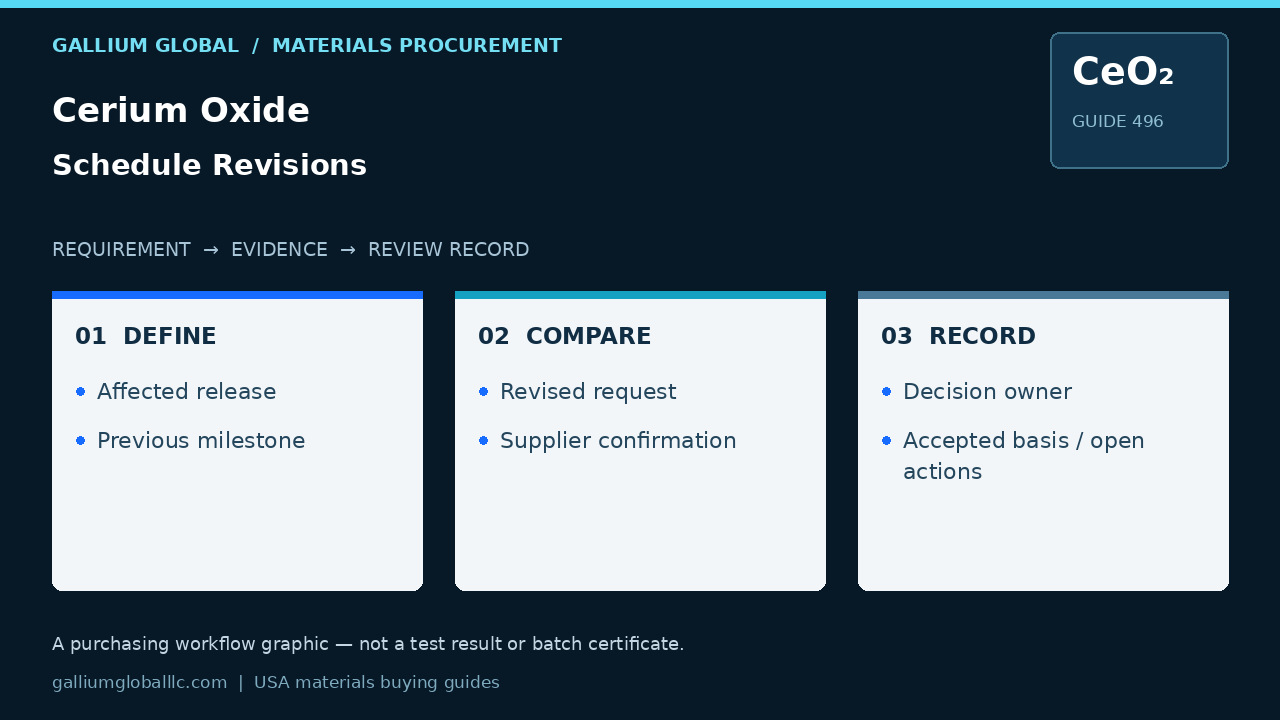
Cerium oxide schedule revisions: review objective
Delivery schedule revisions should preserve the relationship between the old plan and the accepted new plan. Identify affected quantities and releases rather than changing a single headline date. Ask the supplier to confirm which milestones it can support.
Cerium Oxide: identify the material in scope
Identify cerium oxide as the compound required for the enquiry and distinguish it from cerium metal or a different oxide formulation. If the buyer controls a specific formulation or physical condition, put that requirement into the specification response rather than leaving it implicit. Ask which analytical and physical parameters the quotation actually covers. Record the purity or assay basis, any individual impurity conditions and the powder properties relevant to acceptance. A supplier’s general description should be expanded where it does not answer a controlled requirement.
Cerium oxide schedule revisions: evidence record
Create a cerium oxide review entry with these fields: affected release, previous milestone, revised request, supplier confirmation. Keep the requested condition and the offered answer in separate columns. Add a reference to the document, label or written response that supports the answer. If an entry is missing, record a specific open question instead of filling the gap with an assumed value. The material side of the same record should identify compound and formulation, assay or purity basis, controlled physical properties, complete requirement response. This preserves the connection between the purchasing question and the material actually under review.
Cerium oxide schedule revisions: purchasing example
Consider this cerium oxide purchasing situation. A cerium oxide purchasing review may have a complete material name but an incomplete response to powder or assay conditions. Keep those unanswered lines open and identify the evidence required before the technical review can close. A later shipment is brought forward while earlier releases remain unchanged. Update the affected release only and obtain a clear supplier response. The example illustrates a review sequence, not an actual offer or measured result. For schedule revisions, the next action is to identify the unresolved field, name the required response and assign the acceptance decision to the responsible reviewer.
Cerium oxide schedule revisions: supplier questions
Ask the supplier to answer the cerium oxide requirement in its original scope. For delivery schedule revisions, request a direct response to each of the four checklist fields rather than a general assurance. Where the response refers to a document, ask for its identifier and the material or shipment it covers. If the offered form, quantity basis or evidence differs from the enquiry, record that difference as a query requiring a written decision.
Cerium oxide schedule revisions: review handover
Close the cerium oxide schedule revisions review only when its accepted basis and remaining actions are visible. Retain the material description, the applicable specification revision and the relevant evidence references in the order file. For a later release, confirm whether the same conditions still apply. Include the agreed record in the next technical, purchasing or receiving handover so another team does not have to reconstruct the decision from scattered messages.
Cerium oxide schedule revisions checklist
| Record field | What to capture |
|---|---|
| Affected release | Identify the order line, release reference and material quantity concerned. |
| Previous milestone | Retain the last accepted timing and define the event and location it describes. |
| Revised request | State the requested new timing, quantity and destination for the affected release. |
| Supplier confirmation | Record the accepted response, its scope, reviewer and remaining open conditions. |
Keep the material requirement visible
- Compound and formulation
- Assay or purity basis
- Controlled physical properties
- Complete requirement response
Catalog context: Cerium Oxide product enquiry. Confirm the applicable grade, form and supporting evidence in the quotation.
Cerium oxide schedule revisions: 5 essential checks for better planning
Use these five checks whenever a proposed material delivery plan changes. Cerium oxide schedule revisions should explain which release is affected, what timing was previously recorded and what the supplier has actually confirmed. A revised request is useful planning information, but it should remain distinguishable from an accepted delivery commitment.
- Identify the affected release. Record the order line, release reference and material quantity concerned. State whether the request affects one shipment, several releases or the overall supply plan. A single revised headline date may not describe the change clearly enough for purchasing, technical and receiving colleagues to act on it.
- Keep the previous milestone visible. Retain the last accepted timing and identify the event it described. A document-review date, proposed dispatch date and requested arrival date are different milestones. The comparison should show which event is being changed rather than assuming that all dates move together.
- State the revised request precisely. Describe the desired timing, quantity and destination for the affected release. Identify any prerequisites or receiving restrictions that the supplier needs to consider. Keep forecasts, preferred dates and confirmed requirements labelled so the response can address the intended scope.
- Obtain a direct supplier response. Ask which revised milestones can be supported and what remains subject to confirmation. Retain the response with the relevant quotation or order reference. Do not treat an acknowledgement of the request as acceptance of every proposed change.
- Distribute the accepted revision. Record the new accepted basis, owner and remaining actions. Give the relevant colleagues access to the same version. A controlled handover should make it clear which schedule replaces the earlier plan and which releases remain unchanged.
Cerium oxide schedule revisions: distinguish the planning stages
A materials enquiry can include a preferred date before the technical requirement or proposed supply arrangement is fully reviewed. Keep that planning request separate from later confirmed milestones. Record the conditions the supplier identifies and the decisions still required before a release can proceed. This gives the buyer a clearer view of what is known and what is still being assessed.
Cerium oxide schedule revisions should identify whether a date refers to document submission, technical approval, readiness for dispatch, carrier collection or arrival at a stated destination. These events are related, but they are not interchangeable. A change to one milestone can require a separate response concerning another.
Read the shipping and delivery overview when preparing a destination-specific enquiry. The written offer should define the proposed delivery scope and applicable arrangements. General website information should not be interpreted as a confirmed transit time or shipment commitment for an individual order.
Cerium oxide schedule revisions: preserve quantities and release references
Keep the total planning quantity separate from the quantity assigned to each proposed release. When one delivery is brought forward or moved back, identify whether its amount changes and whether the remaining releases are affected. A schedule table should let the reader reconcile the proposed release quantities with the overall requirement.
For cerium oxide schedule revisions, use consistent quantity units and material descriptions throughout the comparison. A package count, a net material amount and a delivery-release number serve different purposes. State their relationship where it matters to receiving or planning, and ask the supplier to clarify any proposed alternative arrangement.
Our recurring materials supply guide provides a broader framework for separating forecasts from release requirements. Use the schedule revision to show the specific change being requested rather than silently replacing the whole program with a different total or packing assumption.
Build a before-and-after schedule comparison
A practical comparison can show the release reference, material line, quantity, previous milestone, requested milestone, supplier response and accepted status. Add a revision identifier and an owner for the schedule. Keep any qualification or document-review prerequisites visible rather than hiding them in notes that the next reviewer may not see.
In cerium oxide schedule revisions, retain the previous accepted plan as a reference and mark it as superseded for the affected scope when the new plan is accepted. This helps the team understand how the schedule changed. It also avoids a situation in which two colleagues use different versions without realizing that their assumptions differ.
Record unresolved questions in a separate action field. A response may confirm one release while leaving another under review. The schedule should show that distinction instead of using a single “confirmed” label for the entire program. Name the person responsible for obtaining the remaining answer.
Cerium oxide schedule revisions: an illustrative release change
Consider an illustrative plan with several proposed deliveries. The buyer asks to bring a later release forward while keeping the earlier releases unchanged. The revised request identifies that release, its quantity, the requested milestone and the receiving destination. The supplier is then asked to confirm which part of the change can be supported.
The buyer retains the original plan and records the supplier’s answer against the affected release. If the response offers a different milestone or quantity, that alternative remains visible for review. The accepted revision should show the outcome and any open conditions rather than making the new request appear automatically agreed.
Cerium oxide schedule revisions in this example involve a change to one release rather than an assumed change to the whole order. The example is a planning illustration, not an actual availability statement, lead time or delivery offer. Each real enquiry should obtain a written response covering its material, quantity and destination.
Cerium oxide schedule revisions: keep technical prerequisites visible
A proposed timing change should not obscure technical questions that remain open. Identify the specification revision, material description and document package being reviewed. If qualification or document approval is a prerequisite in the buyer’s process, state the relevant milestone and the responsible reviewer.
Cerium oxide schedule revisions should retain the connection between delivery planning and the accepted technical basis. A request for earlier dispatch does not by itself accept an unresolved assay condition, physical requirement or evidence question. Keep those decisions visible and ask how any outstanding requirement affects the proposed plan.
The material-identity guide and data-sheet revision guide can help structure the technical record. Use the schedule to identify when the relevant response is needed while retaining the separate technical acceptance decision.
Check destination and receiving arrangements
State the delivery location relevant to the proposed milestone and identify any receiving restrictions. A requested arrival date at one location should not be confused with dispatch from another. If the buyer changes the destination or receiving contact, record that as part of the revised scope requiring a supplier response.
For cerium oxide schedule revisions, separate a change in receiving availability from a change in supply timing. A warehouse may have different intake arrangements without changing the buyer’s total requirement. The schedule record should explain what changed and which action is needed from the supplier or receiving team.
Keep the proposed transport and delivery scope connected to the written offer. Ask for clarification where timing is described without a defined event or location. The purchasing record should let another colleague understand whether a date concerns readiness, dispatch, collection or arrival under the arrangement being reviewed.
Cerium oxide schedule revisions: confirm the response scope
Ask the supplier to identify the release and milestones covered by its answer. A response saying that a request has been received is different from a response accepting a proposed date. Record any stated limitation, prerequisite or alternative so the buyer can assess it against the current requirement.
Cerium oxide schedule revisions should distinguish a preliminary planning response from the accepted basis for an order or release. Where further confirmation is expected, identify the next action and owner. Avoid presenting a provisional statement as a completed commitment in the receiving schedule or purchasing file.
If a revised plan affects other commercial or delivery conditions, record the question and obtain the appropriate review. Do not infer an unmentioned change from the timing response. The schedule should summarize the accepted delivery plan while the relevant quotation and order documents retain their own stated scope.
Align the revised plan with the document register
Store the accepted schedule revision with the quotation, material specification and relevant supplier response. A register entry can identify which plan is current and which earlier version it replaces. Include the affected order and release references so the schedule can be found without searching through unrelated correspondence.
Cerium oxide schedule revisions can also affect the timing of document handovers. Record when a required response or shipment record is expected if that information forms part of the agreed review process. Keep the expected record and its acceptance status separate from the date at which it is requested.
Use the document-register guide to keep identifiers, revisions and status visible. A current schedule should point colleagues toward the accepted evidence and open actions rather than imply that all supporting records have already been supplied.
Cerium oxide schedule revisions: hand over the accepted change
Provide purchasing, technical and receiving colleagues with the same accepted revision. Identify the release that changed, the prior milestone, the new accepted basis and any remaining actions. Explain which releases are unchanged so the team does not accidentally apply one revision to the entire program.
Before issuing the handover, review cerium oxide schedule revisions against the current requirement and the supplier’s response. Check the quantity, event, location and status on each affected line. If a field is unclear, resolve the question or leave it visibly open rather than completing the record with an assumption.
For a later change, repeat the comparison using the current accepted schedule as the baseline. Retain enough history to explain the decision without forcing colleagues to reconstruct every earlier email. A useful schedule record connects the request, response and accepted revision in one reviewable sequence.
Frequently asked questions about cerium oxide schedule revisions
Does a revised request change every delivery?
Identify the releases actually affected. One requested change should not silently alter other quantities or milestones. Ask the supplier to confirm the scope of its response and state which parts of the earlier accepted plan remain unchanged.
Is a requested date the same as a confirmed date?
No. Keep the buyer’s request and the supplier’s response separate until the relevant plan is accepted. Record provisional information and open conditions clearly so receiving and planning colleagues understand the status of the milestone.
What should happen if a supplier proposes an alternative?
Record the alternative against the affected release and identify the reviewer who must assess it. Retain the buyer’s decision and the accepted basis. Do not overwrite the requested date in a way that hides the difference between the original request and the proposed response.
Should a schedule show both dispatch and arrival?
Include the milestones relevant to the proposed arrangement and define the event and location for each. If a date is not confirmed, label it accordingly. Avoid assuming that a dispatch date establishes a particular arrival date without the applicable delivery response.
What makes a revision request clearer?
Provide the order and release references, material description, quantity, previous milestone, revised request and destination. State the technical or receiving prerequisites that need review and ask for a written response identifying what can be supported.
To discuss cerium oxide schedule revisions for a new or recurring requirement, request a quotation with your proposed release plan. Include the material specification, total and release quantities, destination and open timing questions so the supplier can review the request in context.
Continue your review
Quality and technical documentation · General quotation checklist · All buying guides
General reference: NIST reference-material and certificate definitions. The reference is background reading and does not certify the catalog material.