
Cerium Oxide Receiving Labels: How USA Purchasing Teams Can Order Materials Online with Clear Requirements, Supplier Evidence and Receiving Records
This cerium oxide receiving labels guide focuses on packing labels for receiving teams. Receiving labels should help the warehouse identify the material and connect it to the order. For a cerium oxide enquiry, make the requirement and the supplier’s response specific enough for the next reviewer to understand the decision.
Request a material quotation ↗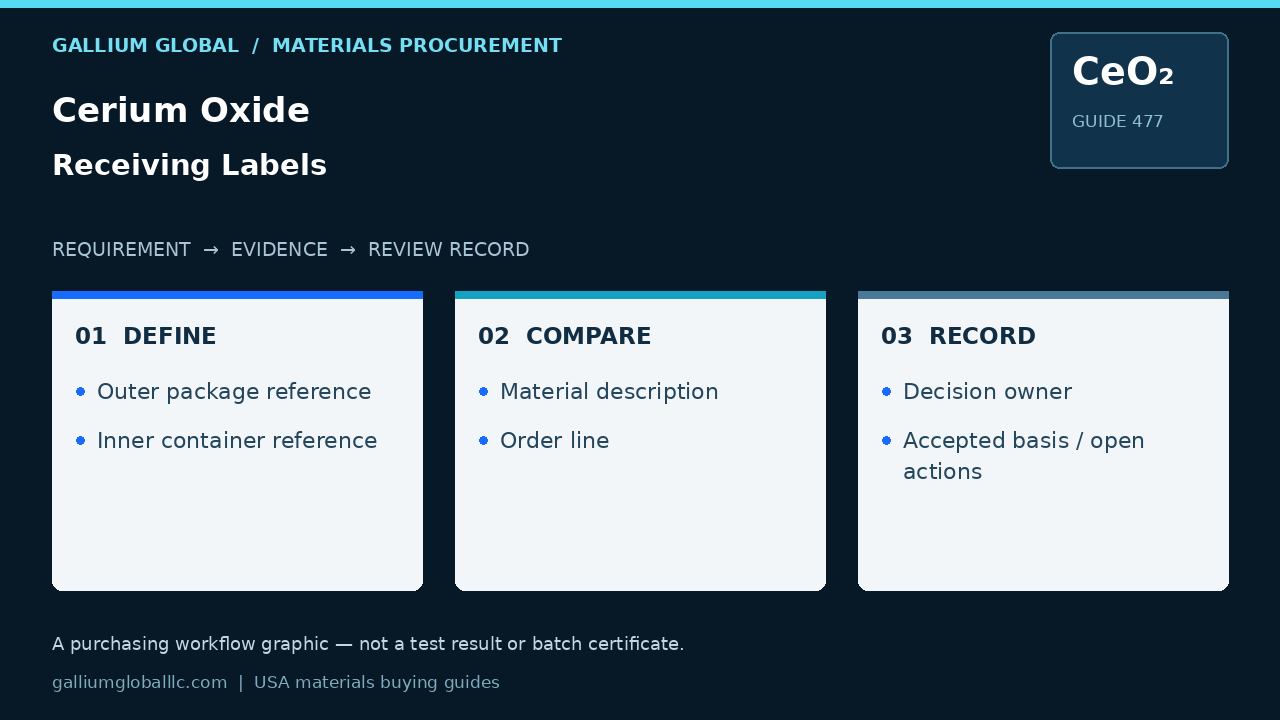
Cerium oxide receiving labels: define the review objective
Receiving labels should help the warehouse identify the material and connect it to the order. Agree which references belong on the outer package and which belong on each inner container. Keep requested business labels distinct from any separate transport marking requirements.
Cerium Oxide: identify the material in scope
Identify cerium oxide as the compound required for the enquiry and distinguish it from cerium metal or a different oxide formulation. If the buyer controls a specific formulation or physical condition, put that requirement into the specification response rather than leaving it implicit. Ask which analytical and physical parameters the quotation actually covers. Record the purity or assay basis, any individual impurity conditions and the powder properties relevant to acceptance. A supplier’s general description should be expanded where it does not answer a controlled requirement.
Prepare the evidence record
Create a cerium oxide review entry with these fields: outer package reference, inner container reference, material description, order line. Keep the requested condition and the offered answer in separate columns. Add a reference to the document, label or written response that supports the answer. If an entry is missing, record a specific open question instead of filling the gap with an assumed value. The material side of the same record should identify compound and formulation, assay or purity basis, controlled physical properties, complete requirement response. This preserves the connection between the purchasing question and the material actually under review.
Worked purchasing example
Consider this cerium oxide purchasing situation. A cerium oxide purchasing review may have a complete material name but an incomplete response to powder or assay conditions. Keep those unanswered lines open and identify the evidence required before the technical review can close. A mixed shipment has a readable outer label but no inner-container references. Include inner identification in the packing instructions if the receiving process needs it. The example illustrates a review sequence, not an actual offer or measured result. For receiving labels, the next action is to identify the unresolved field, name the required response and assign the acceptance decision to the responsible reviewer.
Questions to put to the supplier
Ask the supplier to answer the cerium oxide requirement in its original scope. For packing labels for receiving teams, request a direct response to each of the four checklist fields rather than a general assurance. Where the response refers to a document, ask for its identifier and the material or shipment it covers. If the offered form, quantity basis or evidence differs from the enquiry, record that difference as a query requiring a written decision.
Close the review and hand over the record
Close the cerium oxide receiving labels review only when its accepted basis and remaining actions are visible. Retain the material description, the applicable specification revision and the relevant evidence references in the order file. For a later release, confirm whether the same conditions still apply. Include the agreed record in the next technical, purchasing or receiving handover so another team does not have to reconstruct the decision from scattered messages.
Cerium Oxide review checklist
| Record field | What to capture |
|---|---|
| Outer package reference | Identify the shipment or buyer reference expected at the outer-package level. |
| Inner container reference | Record the identification needed for separately handled containers and the supplier response. |
| Material description | Compare observed wording with the controlled purchasing description and retain any clarification. |
| Order line | Connect the package reference with the relevant material line, release and responsible review record. |
Keep the material requirement visible
- Compound and formulation
- Assay or purity basis
- Controlled physical properties
- Complete requirement response
Catalog context: Cerium Oxide product enquiry. Confirm the applicable grade, form and supporting evidence in the quotation.
Cerium oxide receiving labels: 5 essential identification checks
Cerium oxide receiving labels should help a receiving team connect a package with the relevant material and purchasing record. The review should identify which references belong to the outer package, which belong to individual containers and how those references relate to the order. A readable label is useful identification information; it does not by itself establish that the material meets every controlled requirement.
- Identify the package level. Record whether the observed or proposed reference belongs to an outer package, individual container or accompanying document.
- Connect the order reference. Show how the buyer’s order or release line relates to the supplier’s shipment reference. Retain any explanation of differing codes.
- Compare the material description. Use the controlled purchasing description as the expected basis and record the label wording actually supplied.
- Check allocation needs. Ask whether references remain understandable when containers are separated for the buyer’s receiving process.
- Record differences and decisions. Keep observations, questions and later clarifications separate. Preserve the responsible outcome and any remaining action.
For cerium oxide receiving labels, this checklist addresses buyer reference information and receiving records. It does not provide a regulatory label design or establish transport-marking requirements. The appropriate responsible parties should address those separate matters for the actual material and movement.
Define what the receiving process needs to identify
Cerium oxide receiving labels should support a defined receiving task. Identify whether the team needs to reconcile an order line, distinguish material allocations or connect a container with supporting evidence. State that need in the purchasing enquiry. A general request for clear labels may not tell the supplier which buyer reference is necessary or at which package level it should appear.
Keep the expected references in the current order or release record. If the buyer’s internal item code is relevant, provide the complete code and identify its scope. A receiving team should not have to infer a material relationship from an old enquiry or a code whose meaning is known only to the person who created it.
For cerium oxide receiving labels, the container markings guide supports the upstream instruction and supplier response. The receiving review can then compare the observed information with that reviewed basis. Keep the requested instruction distinguishable from what was proposed and from what the receiving team actually recorded.
Compare outer-package and individual-container references
Cerium oxide receiving labels need a clear relationship between package levels. An outer reference may help route a combined shipment, while individual containers may need separate buyer references for later allocation. Record the actual receiving need and ask for a direct response. Do not assume that a readable outer label makes every separately handled container identifiable.
If the proposed arrangement includes several containers, record how the references connect to the material lines. A package-level matrix can show the expected reference, supplier response and relevant instruction revision. If the package configuration is still provisional, keep that status visible rather than designing the receiving record around an arrangement that has not been offered.
For cerium oxide receiving labels, the purpose is traceability within the stated process. Keep identification questions separate from technical conformity. A missing buyer reference may need reconciliation, but it should not be described as proof of a material-property failure. Likewise, a correct code should not be treated as evidence that every analytical requirement has been met.
Reconcile material descriptions without hiding differences
Cerium oxide receiving labels should be compared with the controlled material description and reviewed supplier response. Record the wording seen at receipt and identify any differing abbreviation or code. The material identity checklist helps organise questions about the relationship between those descriptions. Retain the source wording until the difference is explained.
A general compound name may not state the full grade basis, formulation or physical condition controlled by the enquiry. Use the supporting purchasing record and evidence to frame the question. Do not add an unsupported specification claim to the receiving entry just to make the label description appear complete. The record should distinguish what the label states from what other sources establish.
For cerium oxide receiving labels, a later clarification should identify the material and reference it covers. If the response describes a different lot, package or release, record that scope difference and ask for the relevant answer. A broad assurance should not erase an unresolved relationship between the received reference and the controlled order line.
Keep quantity and package information distinct
Cerium oxide receiving labels may include material amounts or package counts, but the receiving record should identify the unit and scope of each value. A container count is different from a net material amount. The quantity units guide supports that distinction and the relationship between stated contents and the purchasing total.
Compare the expected and observed package information without assuming that every container has the same contents. Retain the supplier’s stated arrangement and ask for clarification where the relationship is not defined. If several releases belong to one order, confirm whether the relevant figure describes the whole plan or only the shipment received.
For cerium oxide receiving labels, package allocation should stay linked to the material and destination references. The split deliveries guide helps organise quantities across releases and sites. A label or document for one release should not be treated as the reference basis for another without an identifiable relationship.
An illustrative mixed-shipment identification question
Consider cerium oxide receiving labels in a mixed shipment with a readable outer reference but incomplete information on separately allocated containers. The receiving team records what is visible at each level and references the relevant order lines. The question is whether the individual containers can be reconciled with the reviewed material allocation. This is an illustrative receiving workflow, not an actual shipment or package arrangement.
The buyer asks for a clarification tied to the affected package references. The response is added to the record with its stated scope. If the original instruction did not define the receiving need clearly, that gap is recorded for the responsible review. The record does not invent an inner-container reference or silently rewrite the original instruction after receipt.
In this example, cerium oxide receiving labels become easier to assess because the observation and later explanation remain distinct. The responsible team can record the basis for reconciliation and identify any follow-on instruction needed for another order. A future purchasing request can then state the package-level identification requirement more clearly without changing the history of the earlier receipt.
Link labels with documents and evidence references
Cerium oxide receiving labels should have an understandable relationship to the documents used in the purchasing review. If evidence is intended to cover specific material, identify the reference that provides the connection. The certificate scope guide helps distinguish representative information from evidence with a stated material relationship.
Keep the document identifier, revision and scope available in the receiving handover. The document registers guide provides a useful index structure. A file in the same folder does not automatically cover every container. Ask the responsible supplier contact to explain the relationship required by the controlled purchasing basis.
For cerium oxide receiving labels, an inspection or document review should remain within its stated coverage. The inspection report review guide supports questions about what was examined and what remains outside the report. Identification information should help locate evidence rather than substitute for the responsible assessment of that evidence.
Record observations before requesting reconciliation
Cerium oxide receiving labels questions should begin with the expected reference, observed wording and affected package level. Record the relevant source or receiving entry. If a photograph or file supports the observation, identify what it shows and which package it concerns. Keep the factual observation separate from a conclusion about the cause or material status.
The discrepancy records guide provides a structure for expected conditions, observations, evidence and resolution responses. Preserve the original entry when a clarification arrives. If the entry itself needs correction, explain the change and retain the history rather than making it appear that the final understanding existed from the start.
For cerium oxide receiving labels, a useful supplier question identifies the order or release, observed difference and required relationship. A response should be assessed against that issue. If it answers only part of the question, keep the remaining point open with an owner and next action. Receipt of a reply should not automatically produce a complete status.
Carry reference changes into the next enquiry
Cerium oxide receiving labels may need a revised buyer instruction when an item code, package allocation or destination reference changes. Record the earlier and proposed values and identify the affected scope. The delivery change control guide helps organise the comparison. An updated internal code should not silently alter the historical record of an earlier receipt.
Use the request a quote form with the current material definition, quantity, destination and package-level buyer reference needs. Ask the supplier to address the requested arrangement and identify any open conditions. A special reference request should not be assumed included merely because the product appears in a catalog or a previous order used similar wording.
For cerium oxide receiving labels, the final handover should identify the current instruction, supplier response and applicable review status. Keep those sources with the individual release record. The shipment record keeping guide supports a traceable file that another team can use without reconstructing scattered correspondence.
Review current references for repeat orders
A previous receiving experience can help define questions for the next request. Check whether the material line, buyer item code and package arrangement remain current. Use the earlier observation as context while obtaining the specific response needed for the new scope. Clear reference relationships can be carried into a new file without treating the earlier resolution as automatic confirmation of future labels or shipment conditions.
Cerium oxide receiving labels: common questions
Is an outer label enough for every receiving process?
The buyer should define its package-level identification need and request a response. Cerium oxide receiving labels should remain understandable for the way containers are expected to be reconciled and allocated.
Does a correct code prove material conformity?
A code supports identification. Material acceptance still depends on the controlled requirement, applicable evidence and responsible review. Keep those roles separate in the record.
Should a later explanation replace the original observation?
Retain the observation and append the clarification with its scope. If an entry needs correction, record the change rather than erasing the history.
What should be sent with a new enquiry?
Provide current material and order references, quantities, destinations and the buyer information needed at each package level. Cerium oxide receiving labels questions should receive an explicit supplier response for the proposed purchase.
Continue your review
Quality and technical documentation · General quotation checklist · All buying guides
General reference: NIST reference-material and certificate definitions. The reference is background reading and does not certify the catalog material.